
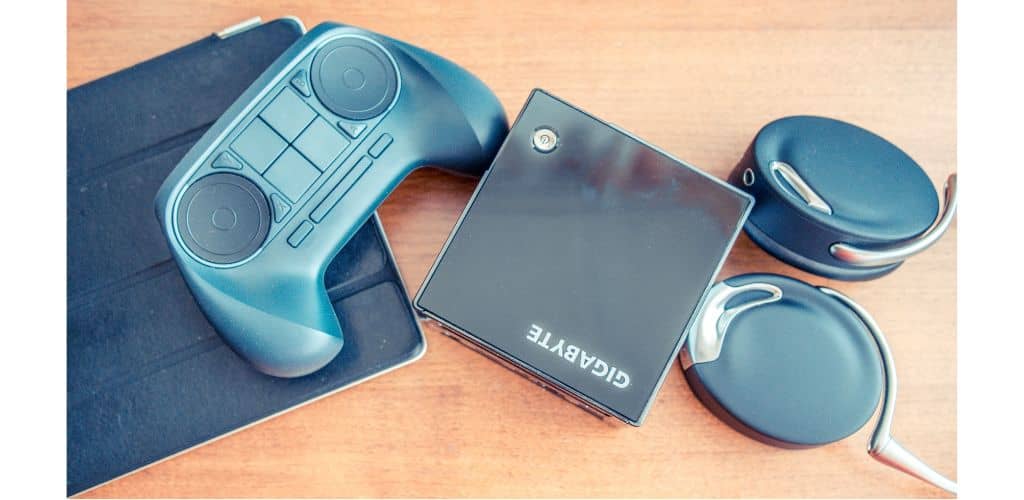
The Federal Circuit has reversed a decision by a Washington State federal court that Valve Corporation was estopped from challenging the validity of patents owned by Ironburg Inventions Ltd. on grounds that weren’t raised in inter partes review (IPR).
Ironburg owns US Patent No. 8,641,525, directed to a video game controller with “one or more additional controls located on the back of the controller in a position to be operated by the user’s other fingers” while the thumb and forefinger rest on the top and front of the controller.
Ironburg sued Valve in 2015, alleging that Valve’s Steam® Controller infringed several claims of the patent.
Before trial, Valve filed an IPR petition (the ’948 IPR) challenging the ‘525 patent. While this IPR was pending, Valve filed a second IPR (the ’136 IPR) based on a prior art reference, Wörn, that it said it had recently discovered.
After the Patent Trial and Appeal Board (PTAB or Board) issued its final written decision in the ’948 IPR, Ironburg moved to terminate this second IPR, based on estoppel under 35 U.S.C. § 315(e)(1).
Under 35 U.S. Code § 315(e)(1),
The petitioner in an inter partes review of a claim in a patent under this chapter that results in a final written decision under section 318(a), or the real party in interest or privy of the petitioner, may not request or maintain a proceeding before the Office with respect to that claim on any ground that the petitioner raised or reasonably could have raised during that inter partes review.
The Board granted Ironburg’s motion to terminate the second IPR, finding that Ironburg had proven that “a skilled searcher conducting a diligent search reasonably could have been expected to discover Wörn.”
The Board found that manual searches of the prior art using patent classifications and subclassifications, as well as using keywords to further narrow the search results to a prior art set small enough to manually review, would have located Wörn.
A third party, Collective Minds Gaming Co. Ltd. (CMG), also filed an IPR petition challenging Ironburg’s patent, based on four prior art references (the CMG Grounds).
Valve then amended its invalidity contentions in the pending district court litigation to raise the CMG Grounds.
Ironburg argued that Valve should be estopped from asserting the CMG Grounds.
The district court granted Ironburg’s motion, finding that since CMG was able to locate its prior art references, “a skilled searcher [for Valve] could have been reasonably expected to find all of these references.”
The case then went to trial on infringement. The jury found willful infringement by Valve of several patent claims and awarded $4,029,533.93 in damages.
An appeal followed. The case went up to the Federal Circuit and then back to the circuit court on remand. The district court again granted Ironburg’s motion for IPR estoppel.
On the second trip to the Federal Circuit, the court concluded that the district court relied on insufficient evidence to estop one ground, and failed to adequately account for hindsight bias in estopping the other ground, and thus reversed and remanded again.
At issue was what prior art a “skilled searcher” should have found without “extraordinary measures” or “scorched earth” tactics.
The “skilled-searcher” test is a legal standard applied in IPR estoppel to determine if a patent challenger should be barred from raising new invalidity grounds in district court.
The Federal Circuit concurrence noted that:
a patentee relying on the skilled searcher test to estop a challenger, pursuant to § 315(e)(2), from pressing a particular ground of invalidity in district court, must prove at least the following: (i) the prior art reference(s) at issue were findable by a skilled searcher conducting a diligent search and (ii) the skilled searcher also reasonably would have been expected to discover, based on the reference(s) found, the invalidity ground the challenger seeks to assert in court.
According to the concurrence, the court held that
in at least some circumstances, “something more” than proving the mere accessibility of a prior art reference is required in order to establish a skilled searcher performing a diligent search would have found the reference.
Just like the haiku above, we like to keep our posts short and sweet. Hopefully, you found this bite-sized information helpful. If you would like more information, please do not hesitate to contact us here: https://aeonlaw.com/contact-us/.