
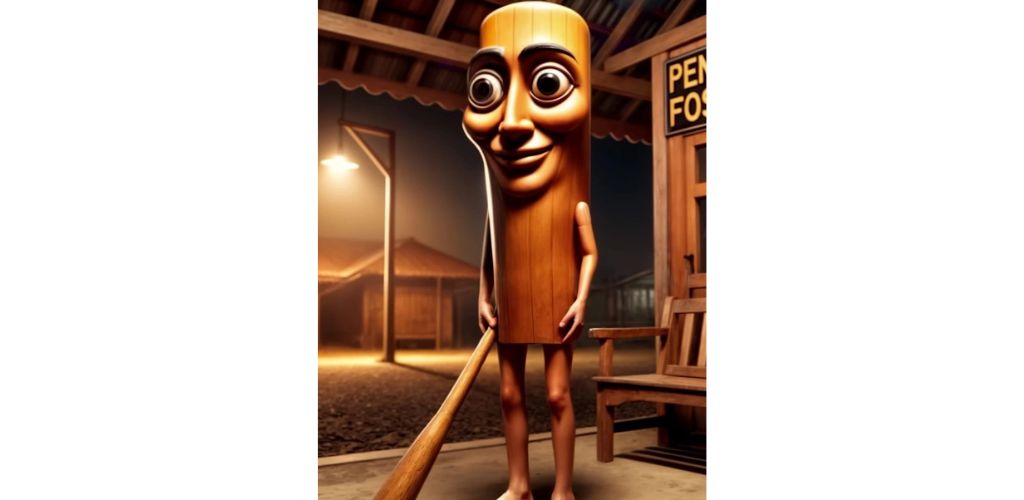
A case is pending in federal court in San Jose, California, over the intellectual property rights (if any) to an AI-generated character.
As Deadline notes,
Now, if you don’t have someone under 18 in your life, or you missed out on the plethora of AI-generated characters that started flooding Instagram and TikTok just over a year and half ago, Roblox, Tung Tung Sahur and other Italian Brainrot offspring like Ballerina Cappuccina, and maybe even the very P&A- friendly Fortnite may just not mean that much to you.
As NPR explains,
Italian brainrot burst forth on the internet in early 2025. The memes are weird, AI-generated characters with faux Italian-sounding names. A cow with the body of the planet Saturn and large human feet is known as La Vaca Saturno Saturnita…
The wildly popular character of Tung Tung Sahur (shown above) looks like a tree trunk with a face and limbs. He carries a baseball bat and sometimes stands on a pile of $100 bills.
Tung Tung was generated by a young Indonesian man named Fernanda Bagas Indrastata who uses the online name Noxa. He “created” the character in 15 minutes using seven prompts with an AI image generator.
Tung Tung is based on a type of Indonesian drum called a kentongan, used to wake people for sahur, the early-morning pre-fast meal during Ramadan.
“Italian Brainrot” characters are now being incorporated into videogames – such as Steal a Brainrot — made by third-party companies.
NPR explained that after the Steal a Brainrot game rocketed to the top of the charts, Do Big, the company that made it, received a letter from a French company called Mementum Lab asking the company to enter into licensing negotiations for Tung Tung, who appeared in the game.
But rather than pay a license fee, Do Big took Mementum Lab to court.
In its amended complaint Do Big stated that “Mementum’s claimed rights do not exist. Under established law, copyright protection requires human authorship, and AI-generated material does not qualify.”
Mementum’s lawyer countered that the Tung Tung character was made by a human and that even if it didn’t take much effort to create it, it should still be protected under copyright law.
“If I sat here right now and drew a picture of something and spent 30 seconds doing that, that could be copyrightable,” the lawyer told NPR.
As NPR notes,
The fight comes at a crossroads for AI-generated art and raises the question of whether prompts to a chatbot can be considered artistic expression. A 2024 case ruled that a chatbot cannot be the sole inventor of a product or piece of art, but it left open the possibility of humans using AI to produce copyrightable works. Last year, the U.S. Copyright Office affirmed that AI-assisted work could be copyrighted but added: “Whether human contributions to AI-generated outputs are sufficient to constitute authorship must be analyzed on a case-by-case basis.”
Way back in 2023, we discussed in this blog how a court agreed with the US Copyright Office that human authorship is an essential party of a valid copyright claim:
Copyright has never stretched so far, however, as to protect works generated by new forms of technology operating absent any guiding human hand, as plaintiff urges here. Human authorship is a bedrock requirement of copyright.
Mementum’s lawyer appears to be arguing that typing a prompt counts as a “guiding human hand.”
As we noted in the blog, the US Copyright Office has also refused to register a visual work that included elements generated via AI.
The work we discussed was entitled “Theatre D’opera Spatial” and submitted by Jason M. Allen.
Allen used a generative AI tool called Midjourney and a series of 600 prompts to create the final work.
We noted that the Copyright Office determined that the work contained more than a de minimis amount of AI-generated content, and that Allen had refused to disclaim ownership of the AI content in his copyright application.
In the Tung Tung case, Mementum has countersued, claiming trademark infringement.
As NPR explains,
The trademark claim … allows the company to focus more directly on whether the company can receive damages from unauthorized use of Tung Tung Sahur, without pursuing the larger philosophical question of whether an AI-generated character is copyrightable under U.S. law.
Just like the haiku above, we like to keep our posts short and sweet. Hopefully, you found this bite-sized information helpful. If you would like more information, please do not hesitate to contact us here: https://aeonlaw.com/contact-us/.